Wednesday, November 16, 2016

Smudge Sticks!

Smudge sticks are considered a staple by people of many different spiritual paths. While Sage smudge sticks are often considered more traditional, there are lots of lovely options out there that include other herbs. Smudge sticks are used to cleanse and purify an area, as well as lending their lovely aroma.


I recently had the opportunity to use two smudge sticks made by “New Age Imports,” a California based company, and both smudge sticks are labeled as made in the USA. They smelled lovely, even through the packaging, and even better once they were opened.

These are quite large smudge sticks, both were just over nine inches long and around an inch and a half in diameter. They are bound very well, not too tight, so that they still burn nicely, but not so loose that the string is falling off.

As you can see, the herbs were still green in color, though definitely dried, leaving them pliable and not crumbly at all. There were a few loose bits that fell off the Lavender bundle when I first took it out of the packaging, but not much at all, and once I started using it I didn't have trouble with pieces falling off.


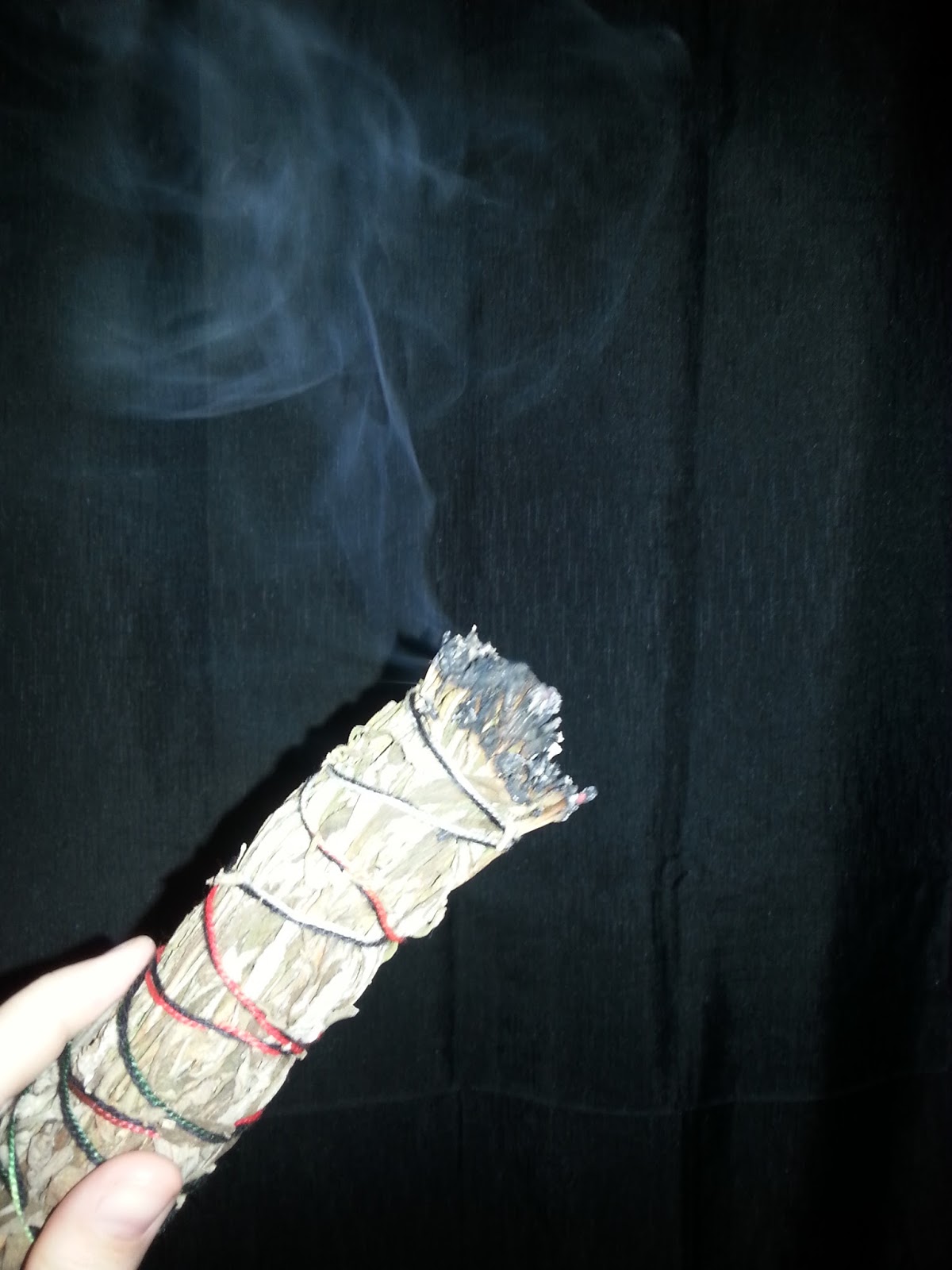
These smudge sticks smell just as amazing once lit, and produced a nice amount of smoke, as I tried to capture here in this picture! I had no problems keeping it smoldering as I was working with the smudge sticks. 

It is a good idea to use a dish or other fireproof container to catch any ash or cinders anytime you are smudging somewhere that a stray spark could cause a fire hazard.


I also pulled some of the leaves out, and burnt them loose, which worked out nicely. I did have to relight them a few times, but they could easily be sprinkled over a charcoal disk or onto a fire!


I like letting mine go out on their own, so I set them over a dish and they continued to burn for several minutes. Before I lit them again, I just used my fingers to crumble some of the excess ash off the tip, and had no problems relighting them.  You can also extinguish your smudge stick by pressing it into a bowl of sand (be sure to shake the sand out before reusing!) or by pressing it against a stone or other hard, fireproof surface.

The aroma of the smudge filled my house and was noticeable for several hours! Both my husband and son enjoyed the scent, and I loved how it made the house smell and feel clean and fresh.


 If you have never tried a smudge stick before, I highly recommend giving these a go!   Not only can they be used around the house, they are wonderful for using before a ritual.  We smudged everyone at the start of our recent Day of the Dead ritual.  It is a wonderful method for cleansing people before they enter circle.  Many people like to smudge their magical tools regularly as well.

Whether your are smudging a person, a place or an object, you simply light your smudge stick so that it is smoldering nicely then fan the smoke over the thing you are cleansing.  You can use your hand, a fan or a feather to direct the smoke where you want it to go. 

I got my smudge sticks from my local store, Green Earth Stones I love going in there, the owner Kathryn is very friendly and always willing to help. I highly recommend anyone in the Bowling Green Kentucky area stop by and check it out, there are often events and classes held right in the shop.  To find out what events are happening or to see newly released items, be sure to follow them on their Facebook page.  If you aren't in the area, you can also order from the Green Earth website, which has a great variety of products.  

These are the specific smudge sticks I used.  Mugwort JUMBO (Black Sage) Smudge stick and Lavender Smudge stick JUMBO

Wednesday, November 9, 2016

Practicing gratitude

I had this topic planned for sometime this month, but in light of the turmoil surrounding the presidential election, it seems extra pertinent. 

Gratitude is one of those things that helps us focus on what is bright and wonderful in our lives.  It brings joy by forcing us to thing about the good things.  It is like lighting a candle in the dark, it can help brighten the area around you.  And the more candles you spark, the more light and warmth you surround yourself with!

It is really easy to be grateful when things are wonderful, but sometimes we don't really let that gratitude sink in.  When someone gifts us with a lovely thing, we may feel that burst of joy and say thank you and in that moment we are fully in a state of gratitude.  But sometimes, that state fades quickly, and it's not that we aren't still grateful or that we don't still love our gift, but it is hard to maintain that kind of emotional high.

It is also very hard sometimes to even think about being grateful when things are rough.  But, not only are those the times where we can gain the most out of a gratitude practice, it is also when the smallest moments of gratitude can make the most difference.

The wonderful thing about gratitude is that it can start small and snowball into something much bigger.  On our darkest days, we may struggle to find anything to be grateful for.  We may have to dial it back so far, that we end up with gratitude like:  I am grateful that I woke up this morning, I am grateful that I am not a hateful person, or I am grateful for friends to cry with.  We may not feel like we can be grateful for the bigger things.

And we may feel this somehow makes us a lesser person...but it absolutely does NOT!  Gratitude is something that spawns deep within, and there are times where we don't feel grateful for things that our brain tells us we should be.  Gratitude is a feeling, it isn't a fact....and if you don't feel it, then you don't feel it!  You may have to dig deep, or get creative with where you look for the gratitude within you.  But it is so very worth it to find those tiny sparks when we are feeling most down.

Gratitude is very personal.  What one person is grateful for might be something that upsets another person.  Or what makes you giddy inside might seem sort of silly to someone else.  Be true to yourself!  Let your gratitude shine out and allow yourself to acknowledge all the tiny (or huge) things that bring you joy!

Every single second we can spend thinking about what we are grateful for is one second that we are NOT thinking about stressful, fearful or angry thoughts.  It is one second of peace and calm in what may be a whirlwind of crazy.  It is one more cry for MORE of what we want in life!  The more we can spend time thinking about, focusing on and calling for the good things, the more we will find them around us.

Never beat yourself up if you are having a horrible day (or week...or year...or life)!  Stop, and find one thing, just one little thing that you like.  Even if it can't bring a smile to your face, even if you are in a place where you just want to curl into a ball and hide from everything, look for that one thing that makes everything a little less bad.  Because sometimes, that is all you can grab onto.  Some days you can't get to good or happy, all you can manage is 'not quite as bad'.  But it is so very vital to find any hope, any light, any joy.

I am grateful for every day and every breath I take.  I am grateful for a husband who may not always agree with me, but still supports my right to argue with him about anything and everything...and underneath it all supports my thinking, feeling and doing things that make me happy.  I am grateful for a son who is growing into his own man, and who has always been loving and respectful towards us.  I am grateful for crayons and scribbled drawings, for color and sparkly markers that turn my fingers rainbow colors when I use them.  I am grateful for song, for chanting, for music.  I am grateful for stories that carry me away when I need to be somewhere that is not here.  I am grateful for flickering flames that mesmerize me.  I am grateful for friends and family who make me feel needed and who miss me when we are apart.

Make yourself a gratitude practice.  There are a million ways to start practicing gratitude..try different ones and see which ones you like and which ones work for you!  When you wake up in the morning, before you even get out of bed, take a deep breath and be grateful for breath and for waking and for a brand new day.  When you drink your coffee, or tea or water, think about your day and the things that you are grateful for that are coming up for you.  When you sit down for a meal, say a prayer of gratitude for the food you are eating, for the plants and animals that sustain you, for the people you eat with, and for the people who are not with you at that meal but still important to you.  When you get ready for bed, think about all the things that happened that day that you are grateful for.  When you lay down and close your eyes, be grateful for rest and sleep and the ending of one day so that a new day can begin.

Start a gratitude journal!  Set aside time every day to write down things that you are grateful for.  Make a goal to write one or three or ten things that you are grateful for.  Whenever you are feeling sad, write down something that makes you happy.  When you feel angry, write down something that makes you calm.  When you are frustrated, write down something that makes you laugh.

Make a collage of things that you are grateful for!  Flip through old magazines and find pictures of things that make your life better, whether they are directly part of your life or not!  I may not interact with wolves, but they are something that has impacted my life in great ways over the years....they would go on my gratitude collage!  A gratitude collage is a great way to honor cycles of time, you can make them at the end of a moon cycle, at Sabbats or for each year.  It can be a lot of fun to then go back and look at these slices of time and see what you were grateful for!

You can also take your gratitude practice and use it to build community!  Write letters to people who have touched your heart, letting them know how much they meant to you.  Share something you are grateful with on social media and ask your friends to post something they are grateful for in return.  Start a gratitude chain:  pick a friend to post something specific about them that you are grateful for, and then have them pick someone and so on!  Or offer to do a gratitude exchange:  let your friends post something about you that they are grateful for in exchange for your comment on something about them that you are grateful for.

The more we stop and notice what we are grateful for, the easier it becomes to honor the wonderful things in our lives.  The more we start to feel that gratitude spread throughout the moments of our days and our lives.  When we are full of gratitude, we can share that gratitude with those around us...we become a beacon of light that shines into the darkness of the world.  The more we search for things to be grateful for, the more we start to notice all the things around us that we have to be grateful for! 

Wednesday, November 2, 2016

Daylight Savings Time

Daylight Savings Time is one of those things that many people are frustrated by.  To many of us, myself included, it seems like an unnecessary hassle, and feels like it creates more trouble that it is worth.  There are many beliefs about DST, from how it came to be to why we continue to do it.  Some people are fans, and I have seen many different arguments for the benefits of keeping with the system.

Most of the time it is farmers that are attributed with the creation of DST, the idea being that farmers would want the extra daylight time.  However, many farmers throughout the years have actively opposed DST.  Shifting how we track time limits farmers in the morning, when many are working to bring their wares to market.  And since animals don't respond to DST, that further complicates things for them.

Two of the earliest people credited with suggesting daylight savings times did so because of their hobbies.  One collected insects as a hobby, and desired extra daylight hours after work in which to pursue his interests.  The other enjoyed morning rides and golfing, and was dismayed to see his countrymen sleeping through the early summer light and hated cutting his golf rounds short at dusk.

But one of the main reasons we observe DST today was because of WWI.  Germany led the way, adopting the practice as a way to conserve coal during wartime.  Many countries followed suit, and though the practice was abandoned during times of peace, it would be reinstated during times of war. 

Some countries have never used DST, and some have used it in the past but do not use it today.  Not all countries adjust their clocks at the same time.  This year, for example, Europe changed their clocks a week before the US.  And while the US changes clocks at 2am local time (so each time zone changes at a different time UTC), Europe changes at the same 'base' time (which means each time zone changes at a different local time).

This of course leads to a lot of confusion.  Not only does each individual need to remember to change their clocks (if they live in a place that observes DST), the time conversion globally fluctuations during this time of the year, making it way more complex to organize things with people who don't live near you.

But under it all, there exists the potential for a unique magical opportunity.  When I was first starting out, I was fascinated by the 'year and a day' concept of time.  It was one of those things that was often quoted in regards to a course of study.  The standard for a degree (back when everyone talked about the three degrees) was to study for a year and a day....and that was after spending a year and a day researching and learning to see if the path was right for you to begin with.

I wondered why the day was tacked on, and then I came across the 'time outside of time' concept.  One of the sources I read listed December 23, as a day of Time beyond Time...and the 'day' in the year and a day.  In some older calendar calculations (particularly Egyptian), in the desire to have months with regular and equal days, the extra days were considered special feast days and not counted as part of the regular year.

While we don't get a full day for DST, twice a year we end up with an hour that is not counted normally.  In the fall, when clocks 'fall back', this means we get an extra hour.  In the spring, when clocks 'spring forward' we loose an hour, skipping it entirely.  This creates a really interesting potential for using this time to do magical work.

In the fall, when we have our extra hour, this is a perfect time to do rituals or workings for increase.  It would be especially good for things that you want to do but never seem to find the time to do.  Another option is to use this extra time to call other bounty into your life....other luxuries or extras you would like to have more of!

In the spring, consider 'scheduling' things you dislike in this missing hour.  You can do this anytime before the time changes and the hours is lost.  You can create an entry in your calendar or datebook and write down the things you want to loose in that time slot.  Or you can make an appointment card or notice on a separate piece of paper, and list all the things you want to skip on it.  This is also a good time to work on things you would like to pass by quicker, as that hour will slip by in an instant!

You can also use the whole time between when DST starts in the spring and when it ends in the fall to honor blessings in your life that you are 'saving'.  Summer months are often quite busy, and we may not take time to notice all the wonderful things in our lives.  And, during the winter months, we may feel starved of all these 'light' things that feel very far away. 

Why not create a Light jar!  Take some kind of container and keep colorful scraps of paper nearby.  When you feel blessed by something, write it on a piece of paper and put it in your Light jar.  You can fill it with as many papers as you like!  If you aren't familiar with this kind of gratitude practice, you may want to set aside a time once a week (or more often!) to sit and think of everything that has made your life brighter and more joyous...and add those to the jar.  You can absolutely add more inbetween, but having those set times helps you stop and take notice and not let the time pass you by.

Then, when DST ends, you can spend the rest of the year, until it starts back up again, using your set aside day to spend time with your 'saved light', reflecting on it and soaking it up!  You could keep your light notes in the jar, or make a collage out of them.  They could become part of a piece of art you display or they may sit in a box on your altar, ready to be sifted through as you need.  You may want to draw one piece of light every day, or whenever you are feeling particularly down.

DST also gives us the opportunity to be closer or further away in time to other people we know.  I've lived in places that observe DST and places that maintain 'standard' time throughout the year.  So sometimes the time difference between me and my family or friends would be more or less than other times.  Or, in the case of DST occurring on different dates, that will give you time between changes when you may be closer or further away in time.  This can give us opportunities to connect with people we may feel distant to...or set up space from people we may feel smothered by.

One of the main times we think about time difference is when calling people in different time zones, so a phone is a perfect symbol to use when working with time and people.  You can take a picture of a phone and on the back of it, write down all the ways you would like to connect with a distant friend.  For someone you want to maintain distance from, use a picture of an answering machine or a missed call message. 

And finally, don't forget that you can do workings to help the actual change occur smoothly.  Plan a ritual for either the night before the change or the morning after (I like to observe the changes in the morning after), to acknowledge the change.  You can ask for a blessing to make your day go smoothly and not be slowed down by the time change, or by people who forgot!  You can also plan your ritual several days before the change, to help prepare.

DST may feel like a hassle, but it can be a very interesting and unusual tool.  We can harness this deliberate alteration of how we perceive time and make it work in our favor, instead of feeling frustrated by it's imposition on our lives.  And sometimes, it is helpful to just take a step back and notice how this thing we have created (time zones, DST, hours, days....time!) can create so much chaos....and ultimately is nothing more than an idea!

Wednesday, October 26, 2016

Magical Pumpkin Carving...and More!

When we think of Halloween, often one of the first things that comes to mind is the Jack-O-Lantern.  It is one of the iconic symbols of the season, and often a fond memory we have from childhood.  I have loved Halloween for as long as I can remember, and carving pumpkins is one of the things that I always looked forward to.

When I was little, we often went to an orchard to pick our own pumpkins.  There is definitely something magical about walking the field and choosing the 'perfect' pumpkin.  I was blessed with parents that had very different outlooks, so I saw things from two different perspectives.  My dad and I carved pumpkins, while Mom painted hers (and then we cooked it!).  Dad loved getting pumpkins with character...so knobby ones, strangely shaped ones or pumpkins with odd looking skin.  Mom liked hers medium sized, smooth skin and pretty perfect looking.  I leaned toward the odd myself.

Once we got the pumpkins home, we would carve (or paint) them!  The first step was always cutting the top open and scooping out the seeds.  Which, if you've never done it, is quite the sensory experience.  The 'guts' of a pumpkin are quite aptly named, a bit slimy, very stringy...and full of seeds.  We always saved the seeds, rinsed them and roasted them for a snack.  If the flesh of the pumpkin was very thick, we would thin it a little (saving what we carved out to cook and blend and keep in the freezer or cube up and add to soup).

We always did faces on our Jack-O-Lanterns.  They might be funny or scary, strange or normal, but it was always a face.  I've seen some amazing other things carved on pumpkins though, from intricate scenes to fancy patterns.  The great thing about a Jack-O-Lantern is that you can make it whatever you want.

Which is why I think they have so much potential!  Not only can you carve up whatever you desire into the pumpkin, you can display it, out in the open, for pretty much the entire month of October..and no one will look at you differently!

Carving gives you lots of room for adding in extras.  If you want to create a Jack-O-Lantern as a magical creation, you can do all kinds of things to tune it to whatever focus you want.  One of the first things you can do is pick your carving medium.  You are absolutely not limited to pumpkins!  Many early lanterns were actually carved in turnips, so think outside the box.  You can carve almost any root vegetable, though of course the smaller ones may be more challenging.  There are tons of decorative pumpkins and squash varieties in the store at this month, and many have very unique shapes that can spark all kinds of creative carving ideas.

But you can also carve fruit!  Apples can make really interesting faces as they dry and shrink.  Oranges can be carved out like pumpkins.  Many of these foods you can also use as cute serving containers for other foods!  Carve faces into bell-peppers and stuff them (or fill them with dip).  Carve apples and fill them with granola and make apple-crisp-lanterns!  Carve your oranges with patterns, stick in some gloves and float them in your punch or hot cider!

While the bulk of carved lanterns involved taking the top off and then carving a face, you can definitely do it different ways.  You might cut the whole bottom off and make a carved dome to place over a candle.  You could take off both the top and bottom, and carve the ring that remains....you could even get fancy and put it on a spinning base to give it movement!

Many people only carve one side of the pumpkin and that is fine, but you can certainly carve things all the way around...especially if you are doing magical carving.  You may want a different symbol for each element or direction, or a different energy facing out than you have facing your house.  You could carve the front for what is seen and the back for what is hidden. 

And, you don't have to stick to regular carving!  If you only carve through the skin, but not the flesh beneath, it gives a different kind of look once you are lit.  And, because the flesh is absorbent, you can dye this skinned area with either food coloring or some other pigment and end up with a very colorful design!  If you add regular paint to your pumpkin skin, you can make a different day and night look (the paint will be mostly unseen at night).  You can even carve patterns in the skin, and then paint a different picture over it to have a colored night time image that is almost invisible during the day!

You can go even more hidden by etching symbols or words into the flesh on the inside.  Use a sharp skewer, the tip of a blade or even a pencil to mark the flesh of the pumpkin.  This is a great place to add more personal details or to elaborate on what the symbols you have carved mean.  If you have specific things you want to draw in or keep out, you can name them.

Once you have carved what you want, you can decide if you want to include other things in your lantern.  You can add herbs or stones, small tokens, or anything else that feels appropriate.  You may want to lay out a small grid inside or just scatter them.  Harder things can be pressed into the pumpkin, or you can even carve little shelves in the flesh for your additions.  You can anoint the inside of your carving with appropriate oil (and then stick herbs to the oil).

Finally, you should pick and bless your candle.  Like any other candle magic, choose a color and shape that matches your focus.  Even though the shape of the candle may not be seen, it will still work (and depending on how you carved, it may peek out for an interesting effect).  As you light the candle each night, say a blessing or chant to activate your lantern.

After Halloween is over, you may want to gather up some of the wax remaining and any stones or big herbs that you added in and make a small sachet with the lantern remains.  You could peel a bit of the pumpkin skin to dry and add to it.  You could also have saved some of the seeds to dry and add in.  Or you could release the whole thing, knowing that it had done it's work!

Have fun with this!  Whether you choose to decorate for the joy of it or to add magic to your decorations, enjoy the season, carve pumpkins (or other things!) that feel right to you, and embrace the magic of this time of year!

Wednesday, October 19, 2016

Making Masks

In my recent moon post about the Full Hunter's Moon, I talked about using masks in ritual, and I thought it would be a good idea to blog about the mask making process.  Masks have been used for many purposes around the world throughout history.  Masks can be simple or ornate, they can be disposable or keepsakes.  Masks can cover your entire head, your entire face, just your eyes or just your mouth.

One of the simplest and most disposable types of masks is one that is drawn on paper.  You can take a large sheet of paper and trace out a shape that will be the form of your mask, and then draw on the paper to decorate it.  Use a bit of string to tie it on, and voila, you have a mask!  This type of mask is great to use as part of a de-masking ceremony, where you make a mask representing a 'face' that you want to shed.  When making this kind of mask, you can pencil in words or write a whole letter underneath, and then scribble or draw over it.  You can use symbols to decorate it or just stick to representing the emotions it represents with color.  Making the mask can be part of your ritual, or you can make it ahead of time (or during a separate ritual), and then start the de-masking ritual already wearing it.  As you take the mask off, you can tell it why you no longer wish to wear it, why it was hurting you, or how it was holding you back.  Then you can burn or bury it.

A slightly more sturdy mask can be made through the process of paper mache.  Add some water to regular white glue to make a thinner paste, and then use this to glue strips of paper onto a form.  Alternatively, you can make your glue from flour and water, which would allow you to use biodegradable materials and leave your mask out in nature as an offering.  The form can be a pre-made mask form, a mannequin head, your own face or even just a rounded bowl.  There are lots of step-by-step guides that will walk you through the process of forming the mask directly on a face, if you wish to try that out.

You can get really creative while making up your basic mask form.  You can add ground herbs to the glue mixture to enhance the basic mask.  There are lots of options for the paper part too.  You can use tissue paper, newspaper, magazines, wrapping paper, and even dryer lint (soak the lint in the glue mixture and press the excess liquid out of it then press it onto the form).  You can write messages on your paper strips, or just key words that you want built into your mask.  Once you have a few paper layers down, you can start adding in other things:  leaves, flower petals, even small stone chips. 

You can really tailor your mask making materials down to the last detail.  Perhaps you want to make a mask to release conventional perceptions of beauty, and you use only magazine pictures of models (or only pictures of more realistic, everyday people!)  For an animal or plant mask you can use pictures on the outer layer to create a photo-montage mask.  A mask for your muse might be made of printout sheets of your own writing (or old journal pages).  Why not make a birthday blessing mask out of wrapping from gifts you received!

The top layer of your mask will be the main part you see, so this is where you can really go wild.  Add feathers or glitter or accent charms!  Punch holes around the edge and add ribbon trim or dangling bits of yarn with objects tied onto them.  Use tinfoil to mold small beads in any shape you can imagine, and paint them (or use nailpolish) to create colorful additions.

You can also make masks with a fabric base, especially if you enjoy sewing.  You can buy felt or fleece pieces that don't require hemming, and use a glue-gun to attach things.  Fabric masks can be painted on or drawn on with permanent markers.  But, you can also use other fabrics, hem them and embroider designs.  This is a great way to turn old clothing or blankets into something memorable, especially if you can make a mask to represent the memory.  You could add quilted places, with spellwork or components tucked into the patches themselves.  Long fabric tubes can become decorations or hair, and things can be added inside of them as well.  

And remember, masks can be highly symbolic.  Making a mask for wolf may have a moon over the forehead and wolf tracks along one cheek or you may just find yourself drawing lines and shapes that 'feel' right and ending up with a geometric pattern in black and grey.

You can make masks for all kinds of purposes.  You might want a set of masks for the seasons, with flowers, green leaves, autumn foliage and bare branches as decorations (or one mask with all seasons represented!)  You may want to do a divine feminine and masculine mask, or have one separated down the middle for male/female.  You can make masks for your animal guides or plants that you connect deeply with.  Masks for deities you work with.  Make masks to represent qualities you want to develop or people who you want to be more like.

You could use masks to help you discover more about yourself as well.  Make masks to represent parts of yourself that you aren't that familiar with, or those that make you uncomfortable.  You can either wear the mask in ritual and spend time really feeling what those parts of yourself represent, or you can meet the mask in ritual by holding it in front of you and speaking to it as if it were someone else instead of just a part of you.

Masks can also be used as protection.  You can make guardian masks, that you can use when you need to take on those qualities, and leave them hung around your house as their own protection in between.  Medical masks can be enhanced and decorated for healing rituals or to ward off sickness.  You can make anonymous masks (all white or all black) to help you keep your identity hidden or to avoid someone who is seeking you out to cause trouble.

Masks don't have to be a static thing either, they can evolve with you over time.  You may make a mask to represent the current year on New Year's, and then every month, every full moon or every Sabbat, you take some time to meditate on your year and add to your mask.  You could have a mask that you work with regularly, and every time you plan on using it, you check and see if you want to change it in any way.  Especially for masks that represent qualities you want to embrace, you may find your needs changing over time, so you might want to adjust your mask accordingly.  If you have a mask dedicated to a deity you work with, you may find bits over the years that you want to add to it as a form of devotion.

Masks are very powerful and versatile tools.  They give you the ability to create what you may need, to step into a role that isn't normally yours or to shed parts of yourself that you want to release.  They can help us to face parts of ourselves that we don't understand so that we can begin to honor all of ourselves.  They let you express what you want to explore in visual and symbolic terms.  You don't need any particular artistic skills to make a mask, just play with what you feel is right!

Wednesday, October 12, 2016

Working with bones

There is a definite stigma with bones, an association with death, and as a society I feel we have lost our connection with that which has gone beyond.  There is a rising number of young people who don't know where their food comes from, who dislike the idea of seeing meat that looks 'like an animal' (as opposed to a packaged, ready to use piece of meat from the supermarket).

I was raised with a very open attitude towards food, and in some ways death.  Whole animals were not uncommon, in fact they were often considered a treat.  We ate almost every part of an animal, and that idea is something that I hope I have continued on with my son (who is a very adventurous eater, and hasn't shown signs of being bothered by eating non-standard cuts of meat).  I don't feel like I was raised to be disgusted by death either.  Open casket funerals were something I remember, as well as Graveyard Day (a Chinese custom of sharing food at the grave and burning paper offerings).

Bones have always fascinated me.  I think they have a unique beauty, and the fact that they were once a living being makes them even more special to me.  I feel that by honoring and using bones, I am showing my respect for the animal that used to inhabit them.  Especially an animal that may have become my food, but also bones that were 'found' or bought.

I have bones that I acquired when I was a child, around grade school age.  I had a grandmother who was very interested in all things desert, and at that time, rattlesnake stuff was very popular.  I have a rattlesnake vertebrae that came with a snakeskin bracelet I bought as a souvenir.  I also have a skull that we think was either cat or rat.  My grandfather found it, he used to find all kinds of things in the woods and bring them back to his storage houses and clean them up.  I loved the skull and he let me have it.  It takes a place of pride on my Samhain altar each year, and lives on my bookshelf the rest of the time.

Since then I have added to my bone collection.  My current athame has a bone handle, which I was so very pleased to find.  As soon as I saw it I knew that I wanted it.  I spent years carving runes into bone staves for my very own rune set.  I occasionally save bones that I like from our dinner table. 

There are a few good lessons I've learned about working with bones along the way.  It is much easier to clean them when any clinging bits are not dried, so soaking them in water helps soften the meat so you can clean it off.  An old, stiff toothbrush works really well for small bits.  I know that if I am making chicken soup, the bones pull away from the meat really easily after cooking (and if you want to split them for any reason, it is much easier when they are soft like this).  But, actually boiling the bones pulls the fat and marrow out from the center and gives them an oily feel.  I did this with a lamb bone before I read up and found out that it is recommended to clean them several times in simmering, but not boiling water.

There are other ways to clean bones as well.  One way, with larger bones, is to put them in some kind of wire cage (where the holes are smaller than the bones) and leave them outside so insects will clean them.  There are also chemicals you can use to help clean bones (though bleach is not recommended)...I haven't done any of this, so I can't say what works well or not.  You definitely don't want to use vinegar on your bones as soaking them in vinegar will leech out the calcium and make them rubbery...unless that is your intention!

I also learned a lot while carving my runes in bone.  I had some old bone staves that I was using, and they were very hard.  I also had some dental tools which is what I was using to carve.  It was very tedious work, basically using the metal tools to scrape my lines over and over until they achieved some level of depth.  There was a delicate level of force involved....press too hard, and it was easy to loose control of the tool and scrape where you didn't intend to (or stab your leg or hand!) but don't press hard enough and you don't leave any mark at all.

What I found very helpful was to wet the area of the bone I was working on slightly.  I used saliva though you could definitely use water if you don't feel comfortable with saliva (I feel the extra connection between me and the bone rune staves was a desirable thing though).  I would wet the area and let it sit for a minute or so, then scrape with my tool.  I also would use a pencil to darken in the area so I could easily see the marks I was making.

One other warning I found, while reading up on bone carving, is that the bone dust is very harmful to your lungs, so you always want to make sure to work in a well ventilated area and/or wear a mask.  This is especially important if you are carving actual figures or items, but is a good idea to do even if you are just etching symbols into bone.

Many small bones are easy to come by, especially if you are a meat eater.  These smaller bones can be excellent for bone staves, divination sets, small tokens or charms, inclusion into spell bags or use in jewelry.  But you may also want larger pieces, either to carve into statues or pendants or to make tools out of. 

You can sometimes find larger bones at the grocery, I have seen sections about five inches long sold for soup, and leg-in roasts or large hams also have larger bones in them that you can clean and use.  If you are lucky enough to have an actual butcher near you, it is possible to speak with them about getting or buying bones.  Another source of bones is the pet store, where they sell bones for dogs to chew on.  Some of these may need more cleaning as they may have smoked meat on the bone still.  And you can find a lot of bones now on-line, sometimes in lots, often already cleaned.

There are a lot of ways to use bones, and once cleaned, they shouldn't have an odor.  Becoming more familiar with bones, especially in the foods we eat (again, I am a meat eater!) helps bring us closer to our food sources and helps bridge that disconnect that many people feel when it comes to the food they eat.  Even if you don't eat meat, you may find a unique connection with animals by working with bones.  I think that it can be a profound experience, and help us find that spiritual reverence our ancestors had with the animals they shared this world with.

Wednesday, October 5, 2016

Beyond the Pantheon

We are blessed to live in a day and age where we have access to belief structures from not only across the world but deep into history.  We know about deities and practices to honor them that come from cultures outside our own as well as from our own cultural heritage.  We are not limited to the religion and Gods of our parents, our village or our homeland.

And this leads many of us to connect with a broad spectrum of deities.  Which brings up issues in many peoples mind.  There is a huge argument about cultural appropriation, and I have some very strong opinions about that myself, which I'll try not to harp on too much!  I do believe though that an honest, heart-felt practice that honors deities that you may not be directly connected through by your race or country of origin isn't a bad thing.

Many of us believe that we may life multiple lives, and that some of those other lives may have been in other cultures.  We may feel a pull to a certain deity that seems like it goes beyond simple interest and is something from our deeper or past self.  We may find certain practices hold a sense of familiarity that we can't explain or fill us with a sense of belonging and 'home'.  I am a firm believer that we should follow where our heart leads, and if my heart leads me to a deity that is foreign to me but feels familiar, then I will work to deepen that connection and discover the relationship that exists between us.

That, to me, is ultimately what deity worship is about:  developing a connection between yourself and the deity.  And if a particular deity is calling to me, I don't feel that other people can tell me it's wrong. 

Another issue that sometimes comes up is when someone works with deities from multiple pantheons.  I have seen it suggested before that this isn't something that people should be doing, and this is another point that I disagree with.

I do think that it is a good idea to be mindful about which deities you call upon for a single ritual or honor together in a shrine or altar.  I think about it much like friends and family.  I have lots of both, and I may have good relationships (of varying degrees of closeness) with them all, but they may not get along with each other.  If I were to throw a party and put people I know don't get along in the same bedroom for the night, I should expect some kind of problems...at the very least they both will probably be a little cross with me in the morning.

Likewise, I think that when we work with deities, we need to be mindful of their personalities and what they stand for....even when we are working within a particular pantheon!  There are plenty of deities in every pantheon that I can think of that don't necessarily get along, or are focused in different areas and might not work well together.

There may be a tendency to assume that deities that effect the same sphere of influence will get along, but I don't think this is always the case either.  Just because two deities are connected to love doesn't mean that they work the same way, and they may not actually work well together.

On the flip side, just because at first glance two deities might seem opposed in their goals, doesn't mean that they actually are.  A war deity and one of peace might be a great combination to end an ongoing conflict quickly and decisively in order to create a peaceful outcome.

It can be tempting to work with every deity that draws your attention, but this isn't always the best way to approach your practice.  The more you work with a given deity, the deeper you will forge that relationship.  This will not only mean that you will better understand them and how they work, but also how you can work together with them.  The rituals and other work you do will them will be enhanced by the depth of your relationship. 

I don't feel there is any kind of technical limit on how many deities you can work with or honor, but I do recognize the limits on my own time and energy.  I may tip my hat to a whole lot of different deities, both within the Norse pantheon (which is my primary focus) and beyond it, but I haven't created deep relationships with all of them.  Much like the relationships with people in my life, there are some that I work with all the time, some that I work with fairly regularly for specific purposes, and those that I honor in passing or only occasionally.

I don't think I will ever have enough time to develop all the relationships that I might like to.  I have very broad interests and I do think that I will always want to work with more deities that I have time for.  I try not to focus on what I can't have however, and instead focus on spending quality time with the deities I feel truly called toward. 

When I work with deities that I don't have a deeper connection with, it is always from a more formal place of respect.  It sort of reminds me of entering someone's house.  If it is a close friend, I am quite comfortable, and I make myself at home.  If it is someone I know decently well, but perhaps don't visit that often, then I may be a bit more reserved.  If it is a stranger, then I feel like I need to be on my best behavior.  That isn't to say that I am ill behaved in places that I am comfortable, but more that I don't feel like I need to be as proper...I can be more relaxed and more myself.

I do not feel like I need to be a close devotee of every deity I work with, not even of every deity I may have images of in my home.  Some I am quite comfortable with worshiping from afar, in a less frequent manner.  Others are definitely a part of my daily life, and a big part of who I am.  I work with deities from different pantheons, and that works for me.

Ultimately, we each have to discover the way that deities fit into our own lives.  We have to develop the relationships we want and work within the framework we have.  Some people may be perfectly happy to stick to one pantheon, or even just one deity, while others may have a large group of deities that they work with from many pantheons.  The only limits are the ones that you have within your own life....only you can determine if you have enough time and energy to honor the deities in a way you feel is appropriate.  So let your heart lead the way, listen to what the deities you are working with want to tell you, and build the practice that works for you!